
TL;DR
Both start at the same price: ChatGPT Plus and Claude Pro are each $20/month on monthly billing. Higher individual tiers differ: ChatGPT Pro lists $100, $200, or $500/month; Claude lists Max at $100/month and Ultra at $200/month. Usage and model access vary by plan.
In Anthropic’s published Terminal-Bench 4.0 comparison, Claude Opus 5.5 scored 66.4% versus 57.9% for GPT-6 Astra, at different effort settings. At standard uncached API rates, Opus’s $4 input / $20 output per million tokens is 60% below Astra’s $10 / $50; long-context, speed modes, and other charges change the comparison.
Context limits depend on product, model, and plan. The GPT-6 Astra API lists 1,050,000 context tokens and 128,000 maximum output tokens. Those API numbers do not promise the same-sized ChatGPT or Claude conversation.
The honest catch: Claude Artifacts gets you roughly 70% of the way to a working app, and both surfaces lack real app-level login. A chat prototype is a decision tool, not a finished product.
Choose Claude for sustained building sessions and agentic code work; choose ChatGPT for quick prototyping, images, and broader context.
👉 Skip guessing which stack comes after the prototype: MoreMagpie helps you compare approaches and carry a clearer brief into your build, join the waitlist.
You Asked an AI to Build Your App. Now What?
You described your idea to a chatbot. Something appeared. It even looked like an app.
But you are not sure you picked the right tool. You are not sure what you actually own. And you have no idea what happens when the prototype hits the wall.
That is the real question for a non-technical founder. Not "which one writes cleaner code," but "which one gets me from idea to something I can show, and what do I keep when the chat ends."
Most comparisons are written for developers choosing a daily driver. This one is written for you.
Here's what we'll cover:
The Quick Comparison: Pricing, Limits, and What You Can Actually Build
About this illustration
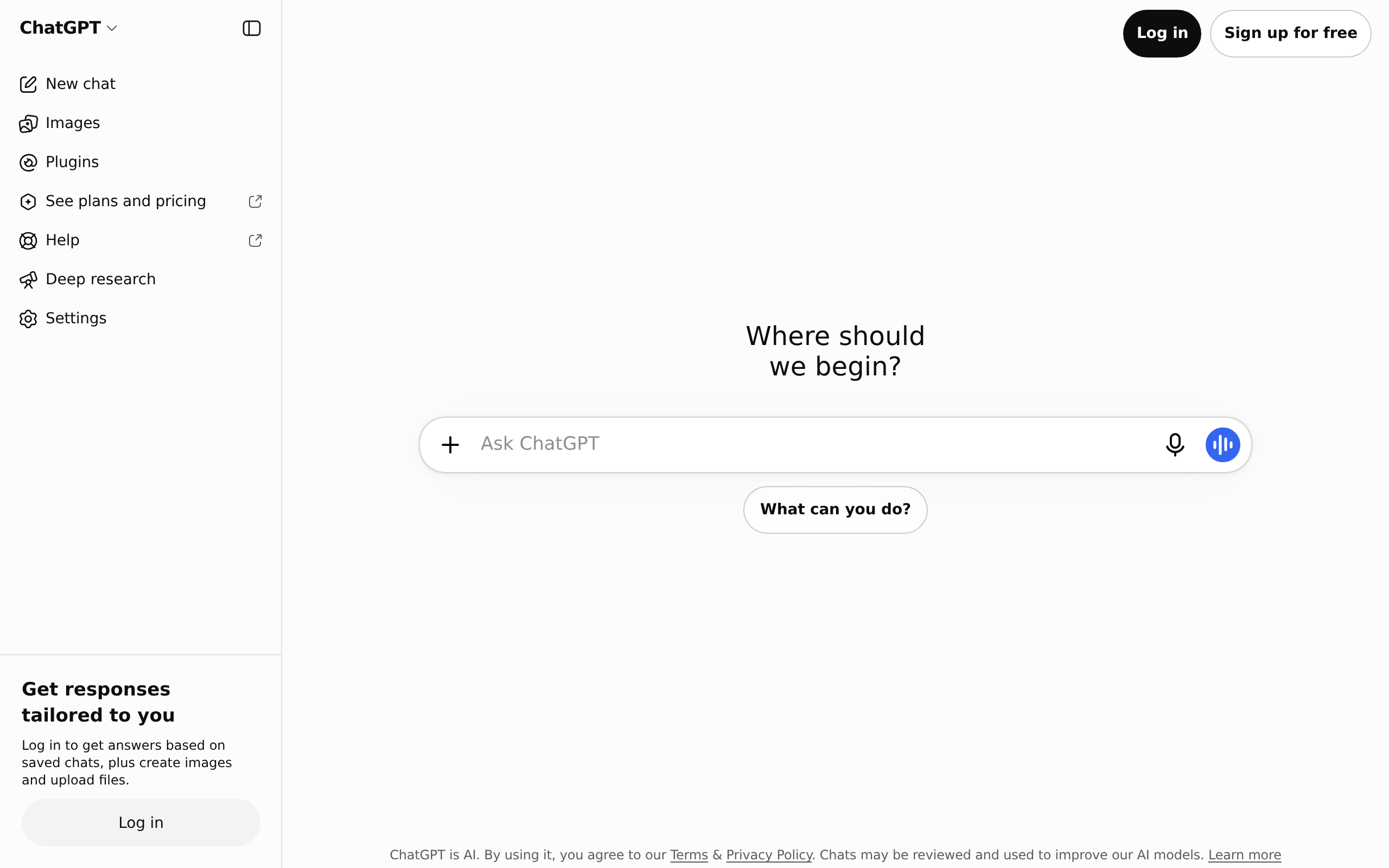
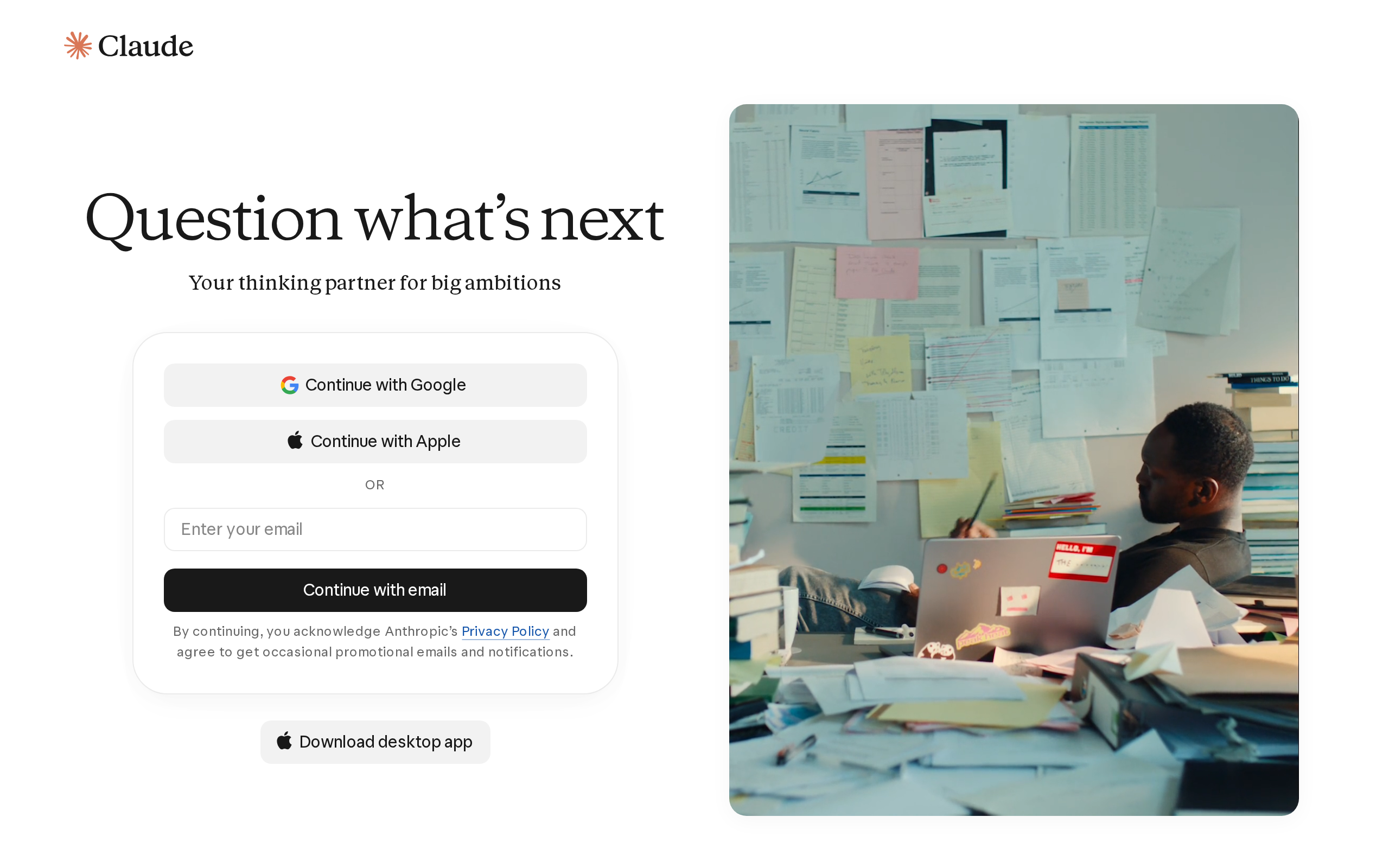
The supplied captures show ChatGPT’s signed-out start screen and Claude’s sign-up website. These cropped website views identify the subjects of the guide; they show no answers to a shared brief or measured comparison.
Here is the head-to-head on numbers that matter for building. Confidence note: the benchmark figures below are vendor-reported at the named settings, not Tested by us. Consumer subscriptions and API billing are separate products.
| Factor | ChatGPT | Claude |
|---|---|---|
| Entry price | $20/month (Plus) | $20/month (Pro) |
| Higher individual tiers | Pro: $100, $200, or $500/month | Max: $100/month; Ultra: $200/month |
| Consumer chat context | Check the exact product, model, and plan | Check the exact product, model, and plan |
| In-chat app surface | Check current preview and sharing availability | Artifacts panel |
| Autonomous coding agent | Codex | Claude Code |
| Vendor-reported Terminal-Bench 4.0 | 57.9% (GPT-6 Astra, high effort) | 66.4% (Opus 5.5, xhigh effort) |
| Named-model standard API rates / 1M tokens | GPT-6 Astra: $10 input / $50 output | Opus 5.5: $4 input / $20 output |
The one-line read: one published agentic benchmark favours Opus 5.5, but that does not settle your workflow, total cost, or finished-app quality. The first answer isn’t the whole picture, so keep reading.
Where Claude Has the Edge for App Building
Claude is the stronger pick when you want to sit down and actually build for a while.
Artifacts: Claude opens code, dashboards, and interactive tools in a panel next to the conversation. You can even publish an app strangers can use with no account. The catch: that no-account access is link-based, which we cover below.
Claude Code: this is an autonomous agent that reads, edits, and runs code in your project. It does the heavy lifting of a real build session, not just answer questions. It is why Claude powers most top developer tools, including Cursor and Windsurf.
Context window: the Claude API documents 1M-token context for named models including Opus 5.5. That is not a guarantee for every consumer plan or perfect retention of a whole codebase; you still need to choose the files and context that matter.
On Terminal-Bench 4.0, Anthropic reports 66.4% for Claude Opus 5.5 at xhigh effort and 57.9% for GPT-6 Astra at high effort, as reported by OpenAI. These are vendor results, not our tests; the launch notes effort, harness, safeguards/fallback and uncertainty differences, including ±2.6 points for Opus 5.5.
Factor verdict: for sustained building sessions, Claude is the stronger tool as of 2026.
Where ChatGPT Has the Edge for App Building
ChatGPT wins when you want to move fast and work across more than just code.
In-chat previews: ChatGPT can render supported code blocks inline, including HTML pages and React components, so you see a simple interface right away. Good for quick "does this look right" moments.
Broader task range: images, voice, multi-modal input, niche languages, and broad general knowledge. If your app idea touches more than code, ChatGPT covers more ground in one place.
Coding models and agents: its coding agent is Codex. OpenAI announced GPT-5.5’s retirement from ChatGPT, ChatGPT Work, and Codex for October 14, 2026, with the API unaffected. Check the model available on your actual plan rather than assume an older benchmark is today’s chat model.
Worth noting plainly: ChatGPT is a conversational AI with strong coding skills, but it does not operate as an autonomous agent inside your project the way Claude Code does.
Factor verdict: for quick ideation, images, and multi-modal tasks, ChatGPT is the faster starting point.
The Top Reasons to Consider a ChatGPT Alternative
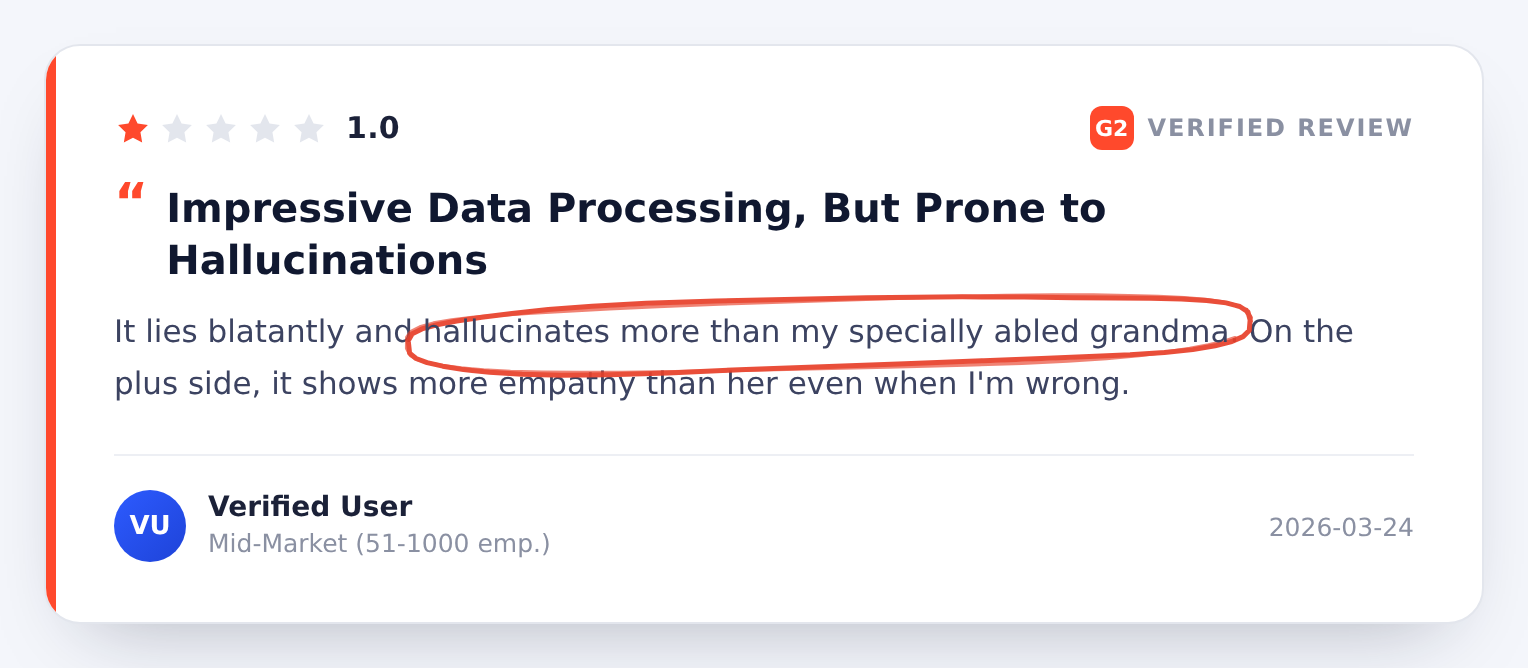
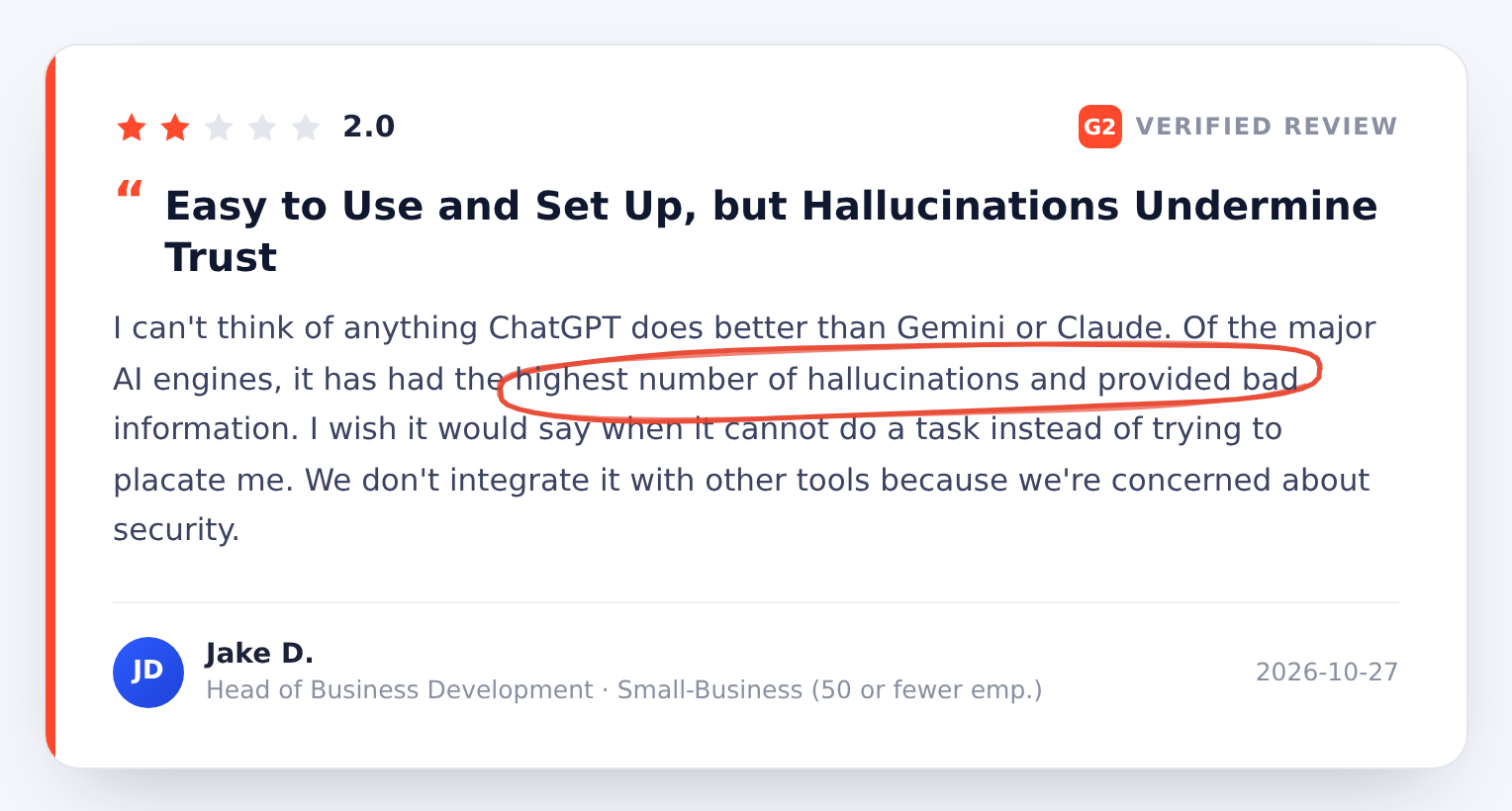
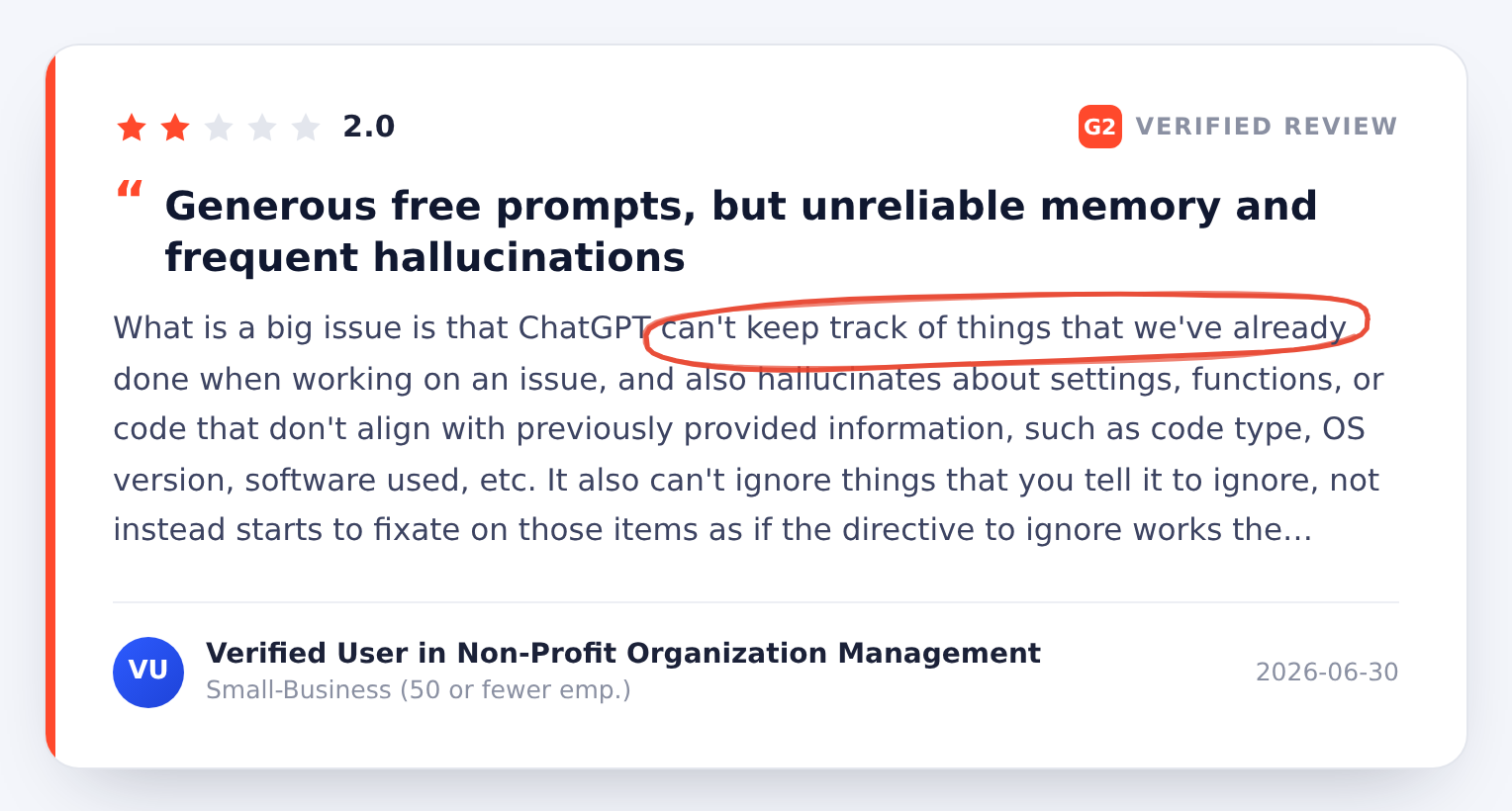
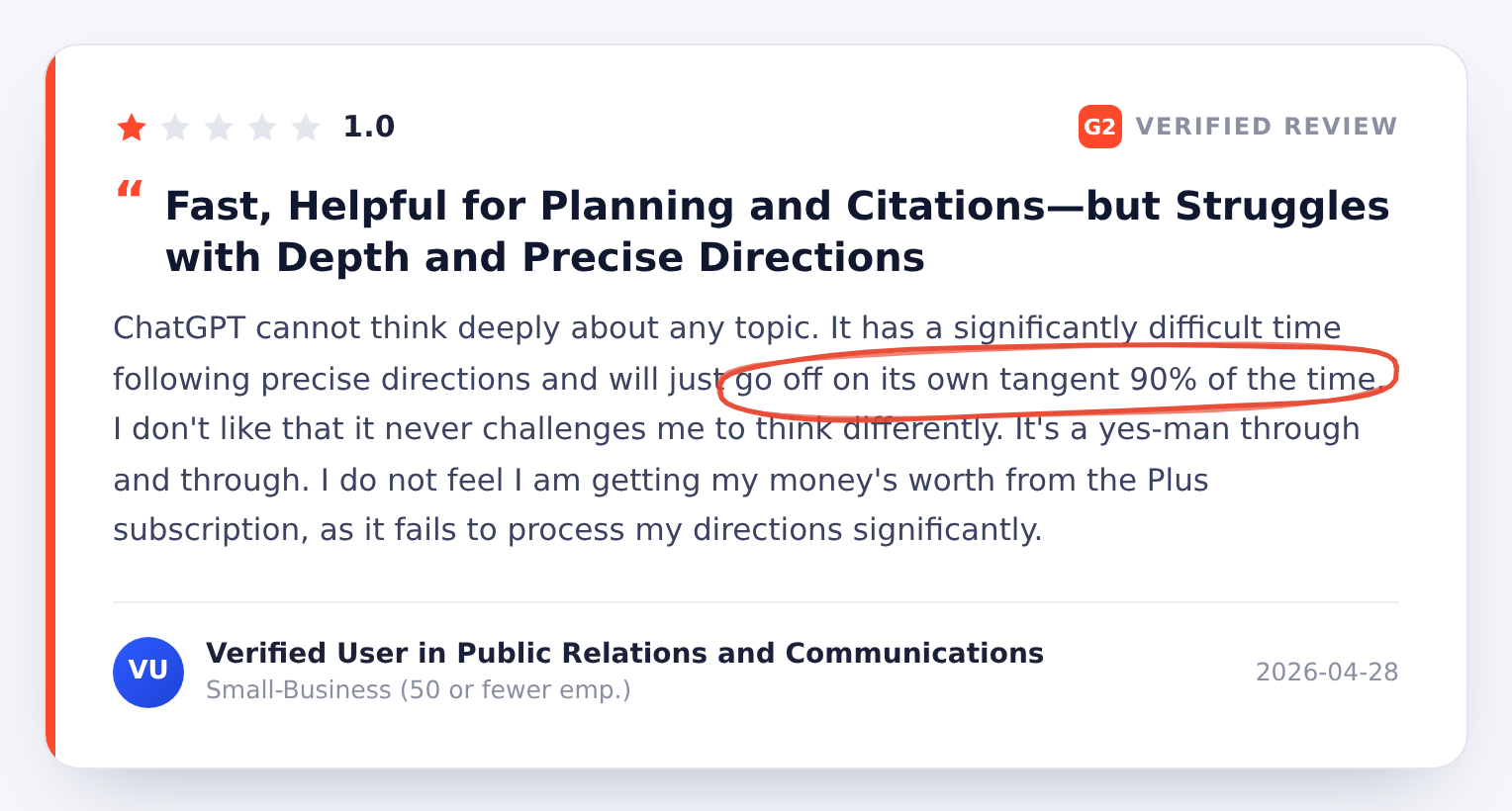
No top-ranking comparison will tell you this, so here is the honest part. Scanning recent 1-to-3-star G2 reviews, a few patterns repeat. Treat these as observed patterns from reviewers, not a verdict on how the product behaves on your account today.
Reviewers report hallucinations and confident wrong answers
Several reviewers describe ChatGPT stating incorrect information as fact, sometimes inventing sources. For a non-technical builder, that means you cannot assume generated code or advice is right without checking.
Reviewers report memory and context slips on longer projects
A build is a long conversation, and some reviewers say ChatGPT loses track of what was already decided, then fixates on things it was told to ignore. That is exactly the pain point in a multi-step app build.
Reviewers report trouble following precise directions
Some reviewers describe getting a yes-man that drifts off-brief rather than sticking to tight instructions. When you need a specific component built a specific way, drift costs time.
Reviewers report workspace and data-handling surprises
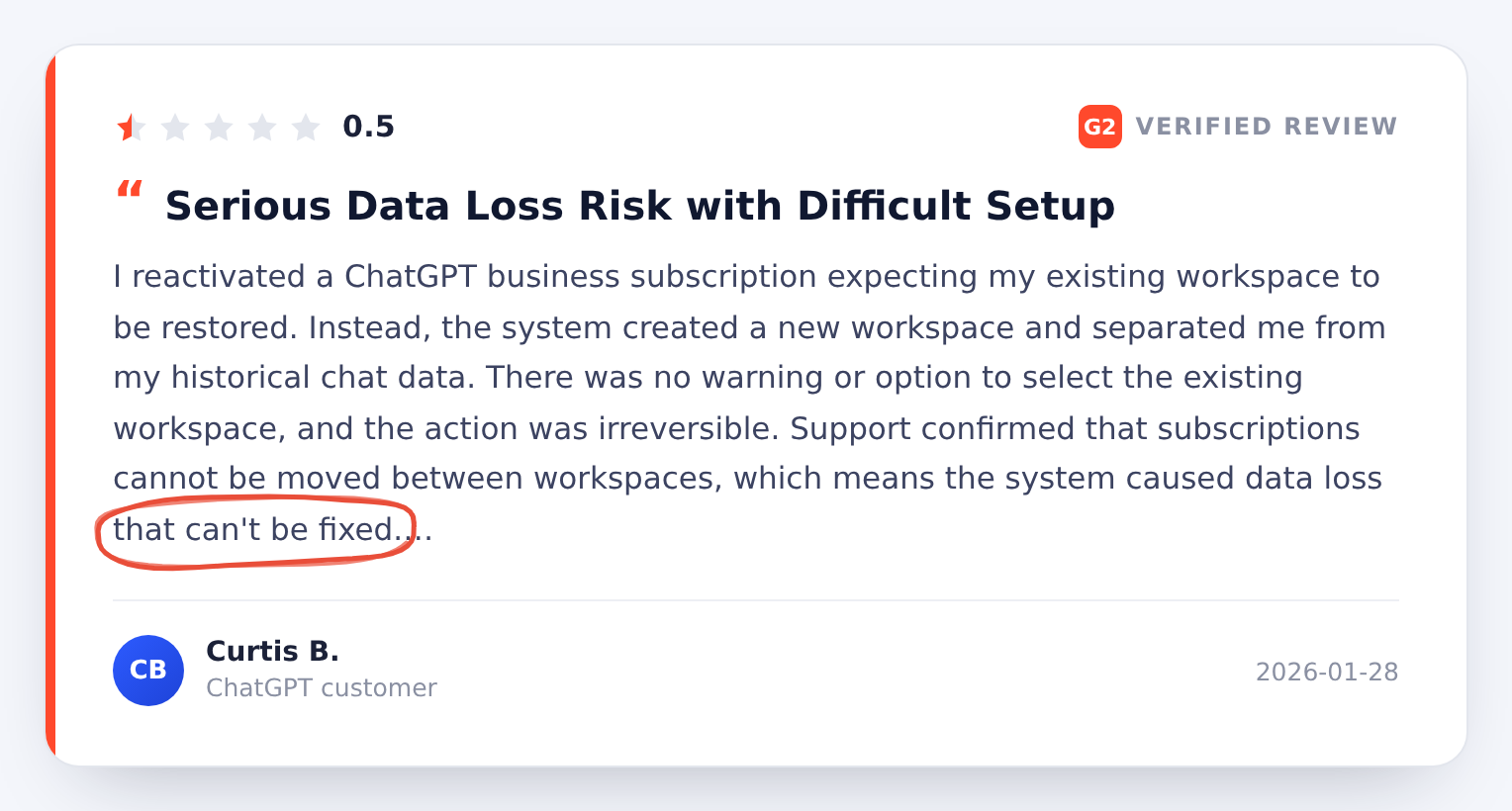
At least one reviewer describes a subscription change that separated them from historical chat data with no warning. If your prototype history lives only in the chat, that is a real risk.
None of this makes ChatGPT a bad tool. It makes it a prototyping tool you should verify, which brings us to the bigger limit both tools share.
The Wall Both Tools Hit (and What That Means for Your Build)
Here is the thing nobody in the top results says clearly to a non-technical founder: neither chatbot is where a real app lives.
You do not get a real database, real login, or a deployable app you control. Claude Artifacts gets you about 70% of the way to a working app, and the last 30% usually requires professional development for production quality as of 2026.
The login trap: Claude Artifacts and Gemini Canvas have no app-level authentication. Access is simply possession of the link. Anyone with the URL is "logged in." That is fine for a demo and risky for anything real.
So what does "building an app in a chat" actually produce? A fast, impressive prototype that helps you decide. Not a product with users, data, and accounts.
Verdict: a chat prototype is a decision tool, not a finished product.
What Comes After the Prototype
The experienced answer in 2026 is "use both." Many developers run ChatGPT for quick ideation and conversational debugging, then hand the heavy lifting to Claude Code for real development sessions.
That is good advice. It is also not the whole decision.
Even using both chatbots, you still have to choose a real stack and a real builder. What database? What auth? What hosting? And what exactly do you brief your AI builder to produce?
That is the moment most non-technical founders get stuck. The prototype answered "can this exist." It did not answer "what do I build it on, and what should I ask for."
How MoreMagpie Helps You Carry This Further
What it does: MoreMagpie is a companion for non-technical founders and AI builders. It is not an alternative to ChatGPT or Claude. It picks up where the prototype ends and helps you turn "I built something in a chat" into clearer choices and a better brief for your real build.
Why it helps: it is built on the idea that the first answer isn't the whole picture. For the same idea, it helps you compare approaches, costs, and trade-offs, so you see more than the one path a chatbot handed you. The goal is clearer choices, not a single recommendation presented as the only option.
Where the catch lives: for every suggested tool or approach, MoreMagpie aims to show what it does, why it helps, how it connects to the rest, and the costs, limitations, and questions still to answer. The auth gap, the database question, the ownership question: these are exactly the catches it surfaces before you commit.
What you walk away with: a brief. MoreMagpie takes you from your idea to the decisions and next checks you carry into your usual AI builder, and it tells you what to ask and what still needs checking.
Worth noting: MoreMagpie is early and currently gathering waitlist signups. There is no pricing or trial yet, just a spot in line.
Which Should YOU Pick?
Match your situation to the tool.
| Your situation | Start with | Why |
|---|---|---|
| Quick prototype to show a stakeholder | ChatGPT | Fast inline previews, broad coverage |
| Sustained solo build session | Claude | Claude Code runs and edits your project |
| Your app needs image or voice | ChatGPT | Stronger multi-modal range |
| You want an autonomous coding agent | Claude | Claude Code acts inside your codebase |
| Choosing an AI editor like Cursor | Claude | It already powers most top editors |
| You hit the 70% wall and need a real stack | Neither alone | Choose a stack and brief a real build |
Honest meta-verdict: for most non-technical founders, prototype ideas in ChatGPT, build in Claude, then move to a real stack with a clearer brief. The tool you prototype in and the stack you build on are two separate decisions.
Frequently Asked Questions
Can you build a real app inside ChatGPT or Claude?
Not a production app. You can build a working prototype, and Claude Artifacts gets roughly 70% of the way there, but neither gives you a real database, proper login, or a deployable product you fully control. The last 30% usually needs a real stack and professional development as of 2026.
Can other people log in to an app I build in a chat?
Not through real authentication. Claude Artifacts and Gemini Canvas have no app-level login, so access is just possession of the share link. Anyone with the URL can open it. That is fine for a demo, but it is not safe for anything handling private user accounts or data.
Which is better for coding, Claude or ChatGPT?
Anthropic’s published Terminal-Bench 4.0 figures favour Opus 5.5 at the named settings, not every app-building task. The 60% price comparison applies to Opus 5.5 versus GPT-6 Astra standard uncached API input/output rates, not subscriptions or a whole build. Match the tool to your actual workflow.
Can I use both ChatGPT and Claude together?
Yes, and many experienced developers do. The common 2026 workflow is ChatGPT for quick ideation and conversational debugging, then Claude Code for the heavy lifting of actual development sessions. Using both plays each tool to its strength, though you still need a real stack and builder for a production app.
Conclusion
The honest answer to ChatGPT vs Claude for building apps is "both, not either." Claude edges real building sessions and agentic code in 2026. ChatGPT edges speed, breadth, and multi-modal work. Neither clears the whole wall alone.
The reality check most founders miss: the tool you prototype in and the stack you build on are two different decisions. A chat prototype proves the idea. It does not ship the product.
That gap is where MoreMagpie fits. It helps you compare approaches, name the catches, and carry a clearer brief into your real build. MoreMagpie is early and gathering signups, so if that is your next step, join the waitlist.